Pages

Showing posts with label Low-cost homeschool. Show all posts

Sunday, October 20, 2013

2013-2014 curriculum

Today I'm sharing what my girls are studying this school year. In keeping with the theme of this blog (and how I choose to live in general), we've not spent a dime more than is necessary. 

I'm going to let you in on a little secret: it doesn't take a boatload of money to properly educate children. If you've got the time and patience to research, a library card, computer access and a nearby thrift store with great books or a homeschool book store, you have all you need for an effective, low-cost curriculum.

If you're considering homeschool as an option, or if you're already teaching at home, be careful of the curriculum bandwagon that equates popularity with proficiency. It drives the cost of curriculum through the roof.

For example, there is a certain computer math curriculum that is all the rage right now.  It cost more than $100 for each grade level, so if you have two kids, you've spent over $200 smacks on math alone.

My problem: math hasn't changed. No matter how many bells and whistles you add to the mix, there is only one way to learn math: memorization of basic facts then learning the formulas. That's it. And you can learn that free online or with a library book or for next to nothing with a pre-owned or less than popular text. If you prefer to teach online or use a website to supplement, there is Kahn Academy, IXL, and a host of other sites to help. Just google.

Know that the cost of a text can have very little bearing on its effectiveness. Though we assume the opposite to be true, there are pricey books that are rubbish and inexpensive books that seem heaven-sent. Personally, I prefer older books, especially history books.

I've gotten the girls' input on occasion. I took Grace with me to our local homeschool bookstore to choose her science book.  I got Beth's o.k. on the free online psychology class after we both found the book she was using a bit boring. (Thank heavens it cost only $2.00).

Though I don't spend any more than I have to, I have decided that should I find a curriculum or text that cost megabucks, I would purchase it if it were the only thing I felt would work. So far that hasn't happened and I've got nearly twenty years under my belt.

Our homeschool days begin the same on Monday through Thursday:  half hour of Bible reading followed by current events. We attend a co-op on Fridays.

The Bible reading is personal. The girls aren't tested and I don't require scripture memorization. (We have an actual topical Bible study later in the week.) We do this because the girls need to read the Word on their own.  I know the Holy Spirit is leading this 'class'. On more than one occasion, we've been studying another subject altogether and one of the girls will mention a scripture or lesson she learned or that was illuminated during that private time.

This is our first year studying current events. Our young people have more knowledge at their fingertips now than at any time but that potential must be harnessed, otherwise peer and social network interaction will stuff them full of the latest boy band or video game.

I teach at our co-op and am still surprised when my students can name every member of One Direction or list the intricacies of Minecraft but can't name our Vice President. And these are juniors and seniors who'll soon navigate the world on their own. Frightening.

 We want our kids prepared spiritually, intellectually and socially.  We use CNN Student News for current events. It's today's news from around the world given in 10 minutes bites. Each broadcast has a lesson plan with vocabulary, study and discussion questions. We've had great discussions during this time, and they're occasionally assigned a research paper. Because we co-op on Fridays, we watch the Monday through Thursday reports. In order to test their long-term memory and their note-taking skills, each Monday starts with a test of the prior week's information before beginning that day's lesson. 

We DVR each program, but you can sign up at the website and watch it online as well.
www.cnn.com/studentnews  Now my girls know Naill, Harry and the guys AND can explain the recent government shut-down.

The girls also study Latin together. We struggled through a popular Latin curriculum but it didn't work for us. We now use Visual Latin. The girls love it. The dvd program is a half hour lesson followed by five or six worksheets. We use the DVD on Tuesdays, then I make up follow up work on Thursdays. www.compassclassroom.com


Because Bethany is older, we've added  Hans Orberg's Lingva Latina to her study. Written entirely in Latin, it supplements Visual Latin's program nicely. In fact, Dwayne- the Visual Latin instructor, recommends it and gives a schedule that aligns the chapters of books. Beth is required to read a chapter or two daily while I check her via Google Translate.

Bethany's 11th grade curriculum:
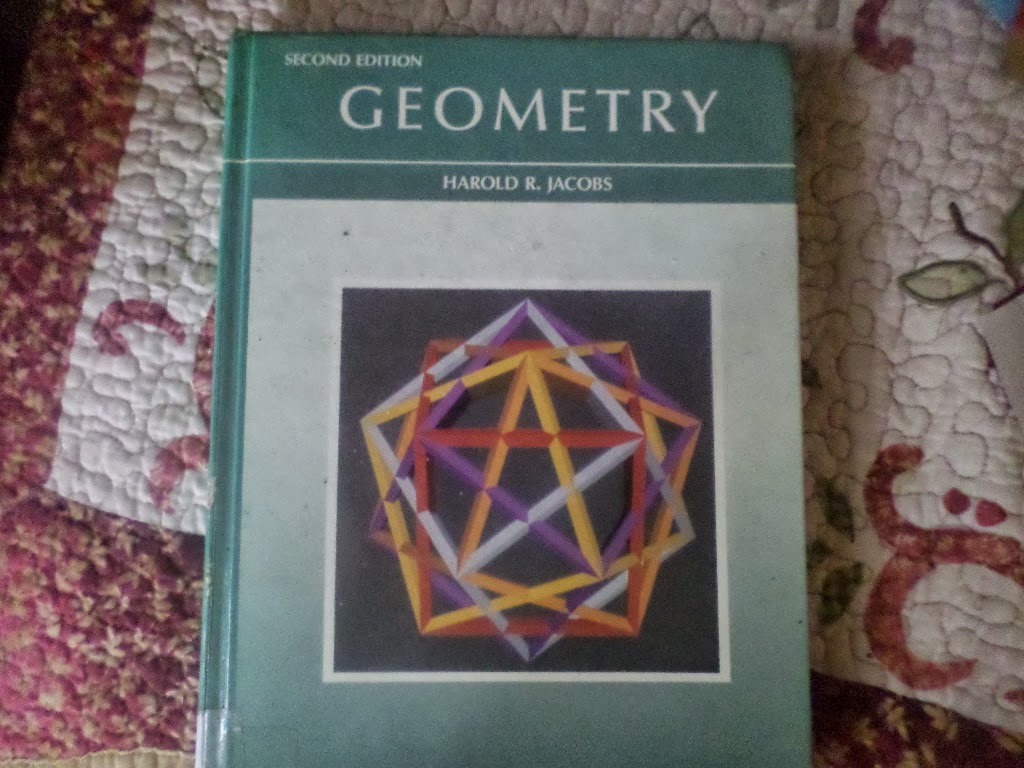
Geometry (Harold Jacobs. Free- library)           
Biology  (Abeka.  $20 text & teacher's book, used)          
Psychology  (Free- online: Carnegie Mellon University)

Bethany also takes a few classes at the co-op: 
    Shakespeare (Free- library book & lecture)
    Economics  (Thomas Sowell. $25 new)
    Drama

Bethany's total: $45


Grace's 7th grade curriculum:
Fundamentals of Math  (Bob Jones. $1)
Physical Science (Prentice Hall   $12.00)
Enjoyment of Music  (Forney and Machlis   $2.50)

Grace's co-op classes:
   Government (no book cost.Teacher worksheets) 
   Grammar  (Easy Grammar $10)
   Geography ($5 atlas. Teacher developed curriculum)
   Math Games  (no book cost. Reinforces facts)
   Worship band  (no cost. Gracie already owns violin)

Grace's total: $30.50
 Beth's total:    45.00
Visual Latin    40.00 (for 30 lessons)
Latin Reader     5.00

TOTAL:      $120.50

What I've paid for two students some homeschool moms spend on one subject for a single child. Again, if you can justify spending that kind of money, go for it. But if you're like most homeschool families, funds are tight as you've sacrificed an income (or least part of an income) so that the children could be taught at home.

Don't think your child's education will suffer because you lack deep pockets. If you take the time to research and plan, you can save money and brain cells when purchasing curriculum. Feel free to drop me a line if you have questions or need help.


Tuesday, October 8, 2013

A word about extra-curriculars

If you've been homeschooling for any amount of time, you may have noticed a trend: overscheduled homeschool students.

It happens quite innocently. Little Johnny or Mary has more time in the day because they're homeschooled so Mommy determines to fill some gaps with outside activities.

Or, Mommy has confused proper socialization with busyness and the family runs hither and yon to varied activities trying to make sure the kiddies have friends.

If your child has a particular hobby they enjoy and both your school schedule and pocketbook can handle it, I see nothing wrong with adding that in.

In my house, we give careful consideration to the extras we allow in our schedule. I freelance from home, so time is just as valuable as money to me. The fact that my husband works nights and I'm automatically the chauffer is also factored in.

How do we decide what to go for and what to exclude? A number of ways.

First, if the activity is a passion, something that each girl will likely carry into adulthood, it's a go. Beth has been taking dance lessons since the age of four, first at our local community center where the cost was drastically lower than dance schools. She's doing some teaching now and plans to dance professionally.


Next, if the activity is a favorite and is used in ministry now, it's allowed.

Grace began playing violin two years ago. She occasionally plays at our church and at a nursing home ministry we have with a group of friends. We tested the waters (both financially and practically) by hiring a homeschool grad who is a college music major as her initial teacher. Grace is  part of the worship band at our weekly co-op and we're considering allowing her to attend another co-op that specializes in music when she begins high school. She's in 7th grade.

Grace playing at a local nursing home
 

Grace (in the middle) playing at the Norfolk Zoo at her summer strings camp recital


We've had a few extras that we stopped.

Girl Scouts was one. Grace became concerned with some of the policies at the national level and I felt our local troops were all but ignored by higher-ups until Girl Scout cookie season.

We got into GS because Grace enjoys community service projects and I was eager for her to make friends.  Volunteering at a local soup kitchen every week and joining my husband on our church's sick and shut-in team met Grace's service project need.  I then encouraged my shy daughter to connect with girls she's sees regularly at our church and co-op. Once that happened the reasons we joined the GS in the first place no longer existed so we left.

Another activity we dropped: soccer. Yipes.  Someone should have told me that would eat up a major part of my schedule, with the twice-weekly practices and back to back games.  Since we were in a homeschool league, we had to travel half an hour each way. Did you know they play in rain and snow?  Double yipes. We dropped that after one year.

Keep evaluating why you're in a certain activity and make adjustments as needed. You could save yourself time, money and peace of mind in the long run.

One final thought: this rush to connect our children with other children is, in my opinion, a bit backward. I feel it's important for our kids to obey their parents and get along with their siblings before we should expect friendships. My girls hear it all the time: 'Inside before outside'. That goes for our home and their behavior/character.

I also believe every effort should be made to ensure the kids are connecting with children already in there sphere-- i.e. church, neighborhood, etc., before branching out, so to speak.

Oh, and don't fall into the 'activity by guilt' trap: so concerned about the dreaded 'homeschool socialization'  that you sign your kids up for a gang of hobbies. It will backfire. You'll be tired, stressed and broke, and once the activities eat into your teaching time (and they will) you'll be frustrated. Don't go there.

Our rules: passion, adulthood, ministry, time and budget. Just a few of my thoughts on the subject. Would love to hear yours.


Thursday, October 3, 2013

Homeschool for Free

I enjoy shiny, new curriculum as much as the next homeschool mom, but I've discovered that if necessary, I could homeschool without spending a dime. It's true. As long as you've got a library card and/or  internet access, it's possible to teach your kids without touching your wallet.

First, make a list of the classes you'd like to teach. Contact your state's Department of Education website for a roadmap of courses if you need help.

Next, head to your library- in person or online. Most libraries now allow you to search their collection from the comfort of your home. After making a list of books that look promising, jot down the call numbers and plan some time when you can drop in and review them, or, if your library offers the service, request a hold or transfer to a branch close to you.

That's how we obtained my 11th grader's geometry book. I'm not strong in math and needed a self-teaching text with an answer key for the teacher. Harold Jacob's 'Geometry' is highly praised on a few homeschool blogs I follow.  After going to Amazon.com to read user reviews (overwhelmingly positive) and checking out the table of contents and a few pages there, I felt like I had a winner.


I discovered my library had the older second edition so I checked it out and kept renewing it.  It was the perfect fit for us.

If/when the renews run out, I'd have no problem purchasing the book, extremely happy that I didn't spend cash on a text that didn't work for us. Been there, done that.

If I hadn't gone this route, there are a number of websites that offer with math. Khan Academy is one of most popular.  You are taken step-by-step through even the most complex math operations. Khan also teaches other subjects.

http://www.khanacademy.org/

I use 'Cool Math' and 'Math is Fun' for my middle schooler. My local homeschool store (www.MooreExpressions.com) had a sale on BJU math book, teacher's text and test booklet for - wait for it-- one whole dollar. That's right: $1. That's not free, but it's the next best thing.  It's an older book, but math doesn't change.


 I introduced new math facts at either 'Math is Fun' or 'Cool Math' then supplement with extra practice in the BJU text.

www.mathisfun.com


www.coolmath.com


The mom behind Easy Peasy Homeschool has a legion of thankful fans. After developing her own curriculum, she shared it online free. All subjects from first through 12th grades are included.

http://allinonehomeschool.com/

If you're a fan of the Charlotte Mason teaching method, you're in luck as a homeschooler. Ambleside Online offers grade by grade guidance resources.  Even you've never heard of the CM process, check it out. It's impressive

http://amblesideonline.org/


I plan to discuss foreign language in a separate post, but know that most libraries offer free language training. Ours in Portsmouth is called Rocket Languages and is accessed on the library's website.

 My rising 7th grader decided to study Spanish over the summer and we chose a BBC website.  A friend recommended it after firming up her Italian for a trip to Italy.  This website, coupled with a Spanish dictionary we checked out of the library, was Grace's summer language training. Click on the language you want from the box in the middle of the screen. The class is actually a 12 week novella. Extra grammar and vocabulary training is included, as well as ground history on the language and culture. My daughter enjoyed it.

http://www.bbc.co.uk/languages/

A google search of ' homeschool for free' or 'free education online' yields a wealth of resources. Take some time to research, saving appropriate sites under your 'favorites' tab with a separate file for science, math, language arts, etc.

Here are a couple more:

www.brainpop.com

http://www.freelyeducate.com/


In another post, I'll show you how to develop an effective curriculum for these sites and library books.


If you put in a little research time, you can homeschool without spending a dime.